The main points
- A group of three small uninhabited volcanic islets off the north coast of Milos, known for hexagonal basalt columns that rise straight from the sea.[1]
- Boat tours around Milos start from Adamantas, in the centre of the island, and cruises from Pollonia also head north to Polyaigos.[2][3]
- The sailing season runs May through October, with Aegean water at 23-26°C (73-79°F) from July to September.[4][5]
- Milos Boat Tour: Kleftiko & Polyaigos Swimming With Meals, from US$185, listed at 10 hours and rated 4.82 from 282 reviews.[6]
- Reserve now and pay later, with free cancellation up to 24 hours in advance on the main listings.[6]
- Top choice Kleftiko & Polyaigos tour from US$185 Duration10 hours[6]Rating4.82 from 282 reviews[6]Live guideEnglish[6]Free cancellationUp to 24 hours in advance[6] Check availability
- Milos & Polyaigos sailboat from US$144 Duration10 hours[7]Rating4.92 from 1,913 reviews[7]Live guideGreek and English[7]Free cancellationUp to 24 hours in advance[7] See this tour
- Half-day Kleftiko speedboat from US$155 Duration5 hours[8]Rating4.93 from 648 reviews[8]Live guideEnglish[8]Free cancellationUp to 24 hours in advance[8] See this tour
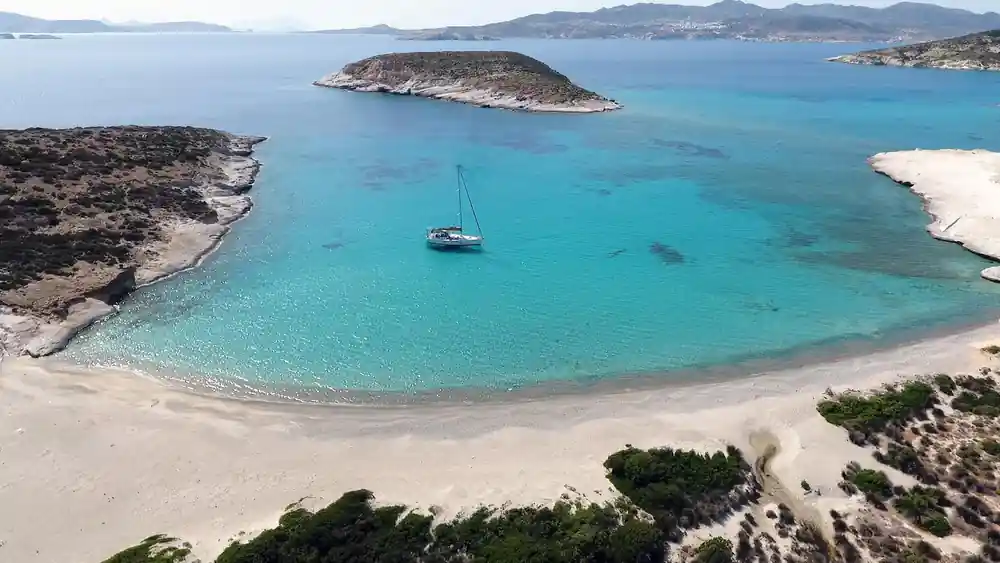
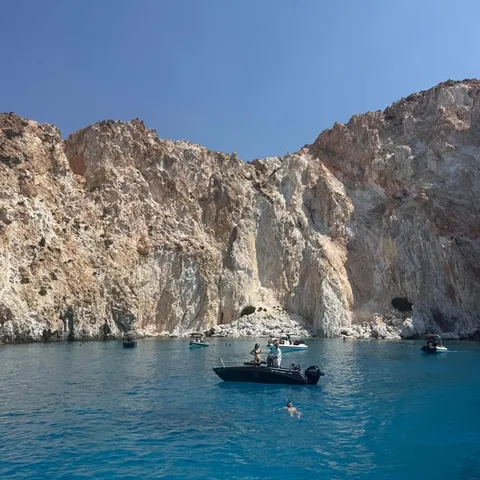
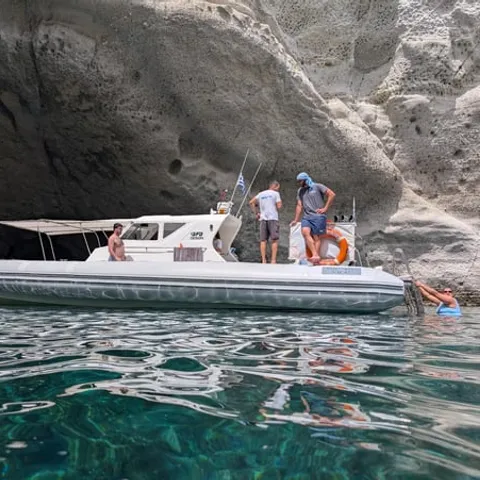
Glaronisia are three small uninhabited volcanic islets off the north coast of Milos. Their name means Seagull Islands, and they are famous for striking hexagonal basalt columns that rise straight from the deep blue sea.
Is the Kleftiko and Polyaigos boat tour worth it?
Check before booking
- The sailing season on Milos runs May through October[4]
- Reserve now and pay later on the main listings, with free cancellation up to 24 hours in advance[6]
- Prices are from-prices, and the Kleftiko and Polyaigos day tour starts at US$185[6]
- Cruises from Pollonia to Polyaigos run as small groups, limited to 10 participants[3]
Rock that looks man-made
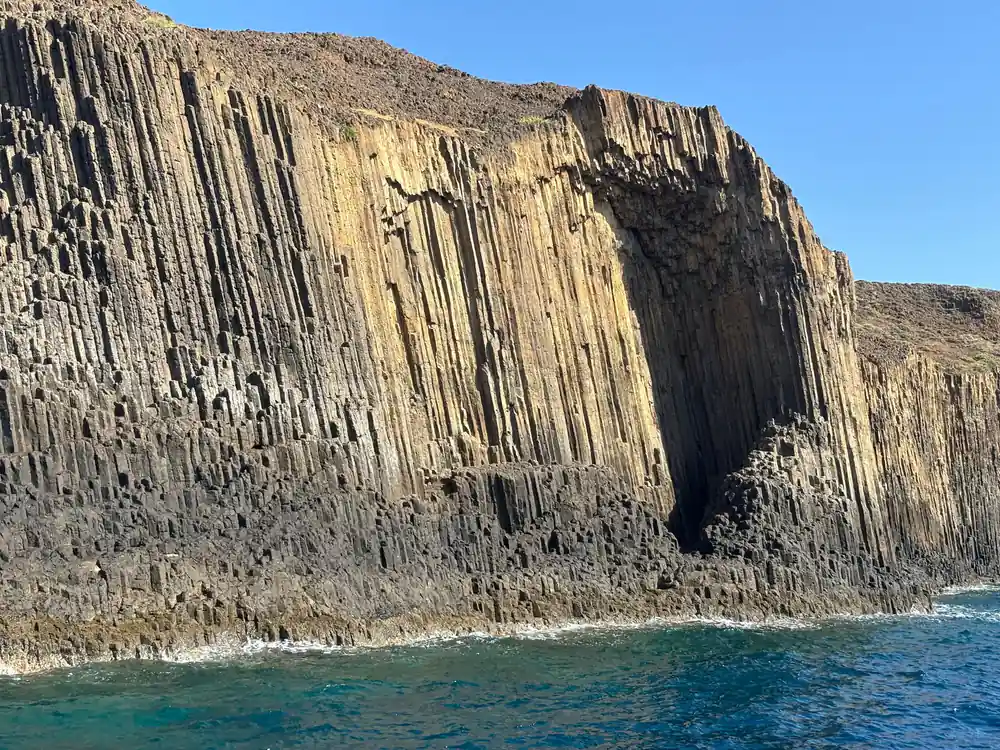
From the deck, the columns at Glaronisia look like something a mason cut and stacked. They are not. Glaronisia is a group of three small uninhabited volcanic islets off the north coast of Milos. Their name means Seagull Islands, and they are famous for hexagonal basalt columns that rise straight from the deep blue sea.[1]
Seen from the water, the columns stand in a tight row along the cliff, pale grey in full sun and almost black where the swell keeps them wet. Each one is a rough hexagon, packed against its neighbours like pencils in a box or pipes in an organ. Above them the rock is broken and ledged, which is where the gulls nest. Nothing on the islets is built, planted or lived in, so the only movement is birds, water and the shadow of your boat.
This is the northern face of Milos, the wild side of the island, and Glaronisia is the piece of it that people photograph most. The best view is from a boat standing off a little way, where you see the columns in profile and the water below them at the same time.
How cooling lava makes a hexagon
The columns are a cooling pattern, not a carving. When a thick flow of lava stops moving it begins to lose heat from the outside in. As it cools it contracts, and the contraction has to go somewhere, so the rock cracks. Those cracks start at the cool surface and run inward, spacing themselves as evenly as the rock can manage. Where the cracks meet, the angles settle into an even pattern, and a shape with straight sides of roughly equal length is a hexagon. Multiply one hexagon across a whole flow and you get columns.
Cooling speed decides how wide they are. A flow that cools slowly, insulated by the rock around it, produces thick columns. A flow that cools quickly produces thin, crowded ones. The same process shapes basalt at the Giant's Causeway in Northern Ireland, at Fingal's Cave in Scotland and at the Devil's Postpile in California, so what you see at Glaronisia is a local version of something basalt does wherever it cools in bulk.
Milos has been volcanic for a very long time. Mineral activity here began around 8000 BC with the mining and trading of obsidian, a hard black stone of volcanic origin used for tools and weapons.[9] The columns are the most photogenic chapter of that long, hot history, but they are not the only one.
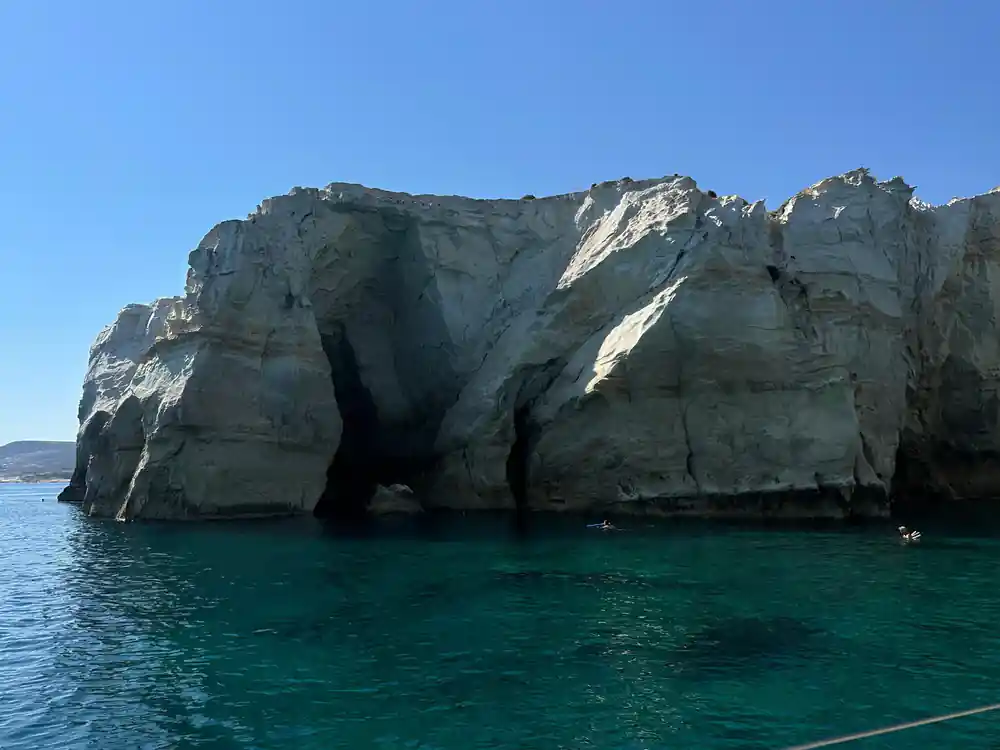
The basalt columns of Glaronisia seen from the water off northern Milos
What the basalt says about the island
Glaronisia is not a one-off. The same volcanic history that cracked these columns into shape built the whole north of Milos and the islands beyond it. Polyaigos, the low dry island you pass on several of the same boat trips, is the Aegean Sea's biggest uninhabited island.[10]
Ashore, the same story shows up as white rock and coloured cliffs. Sarakiniko, the most well-known shore on Milos, is only five kilometres from Plaka, and its pale smoothed rock is volcanic material worn by wind and water.[11] If you have a day on land either side of your boat trip, that contrast is worth chasing.
Look at the hills behind the port as you sail out and you are looking at the same family of rock, softened by weather and cut by the road. Glaronisia is simply the version that cooled in the most orderly way, and it is best seen from the sea.
The name, the birds and the quiet
The name tells you what to look for first. Glaronisia are three small uninhabited volcanic islets whose name means Seagull Islands, and the birds are the loudest thing you hear once the engine stops.[1]
A few habits keep the site calm. Keep your distance from nesting ledges, follow whatever the crew asks, and leave the drone in your bag. Guano, salt spray and sharp rock give the ledges their white streaks, and watching from the water is both the kindest and the most comfortable way to see them. There is no need to land to get the picture you came for.
The islets are small and there is nothing on them to visit: no path, no beach bar, no shade, nothing to buy. That is exactly the point. You come for a few minutes of rock and birdsong, then the boat moves on towards the bigger swimming stops further south.
3 islets
Three small uninhabited volcanic islets off the north coast of Milos, whose hexagonal basalt columns rise straight from the sea.[1]
The caves on the same route
Sykia Cave was once completely covered, and at some point its roof collapsed, leaving a cave with an open top that shows the blue Aegean sky.[12] Boats slip inside when the sea allows, and the light falls through the hole instead of the entrance, which is what makes the place feel like a room with a skylight.
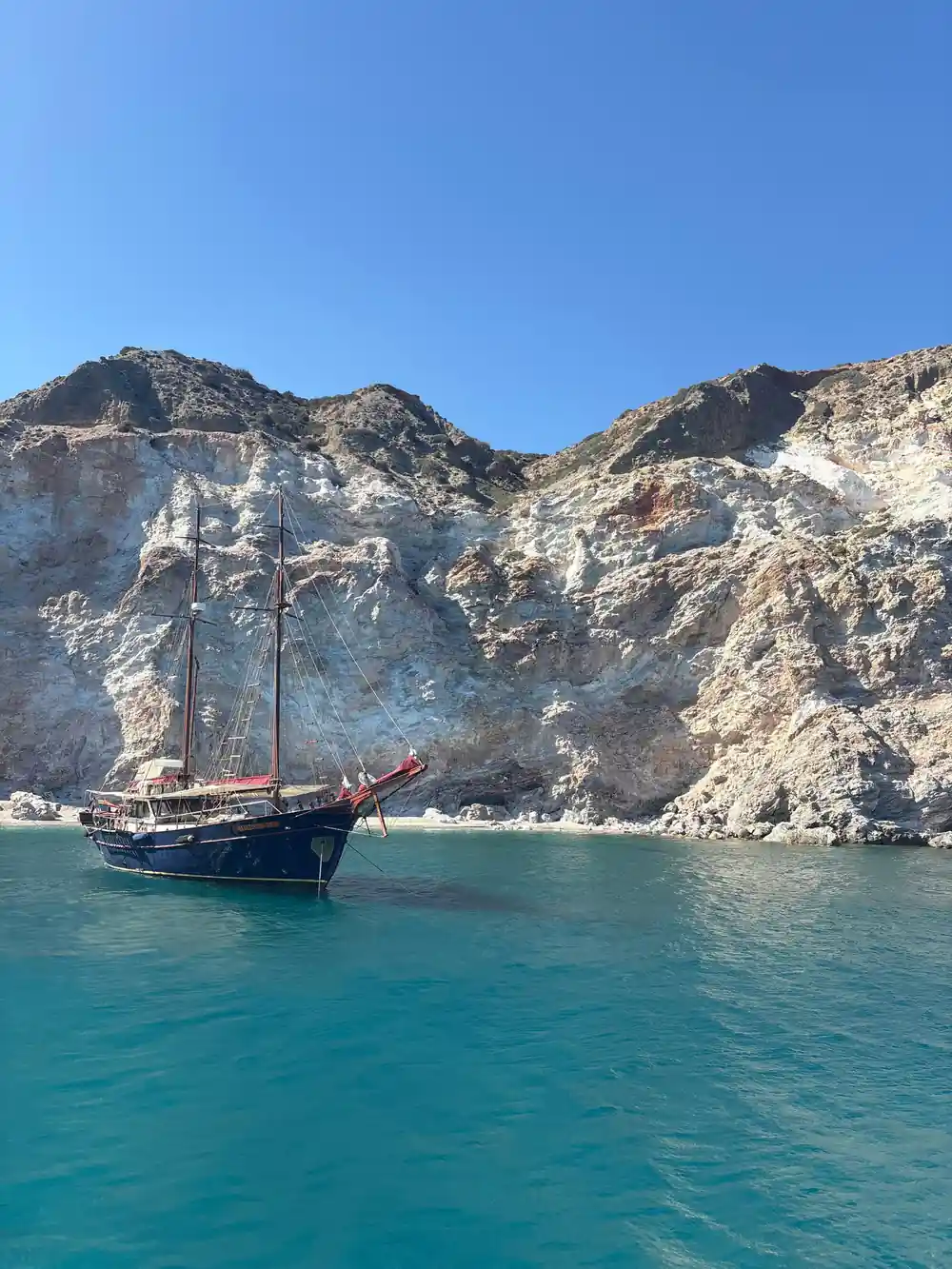
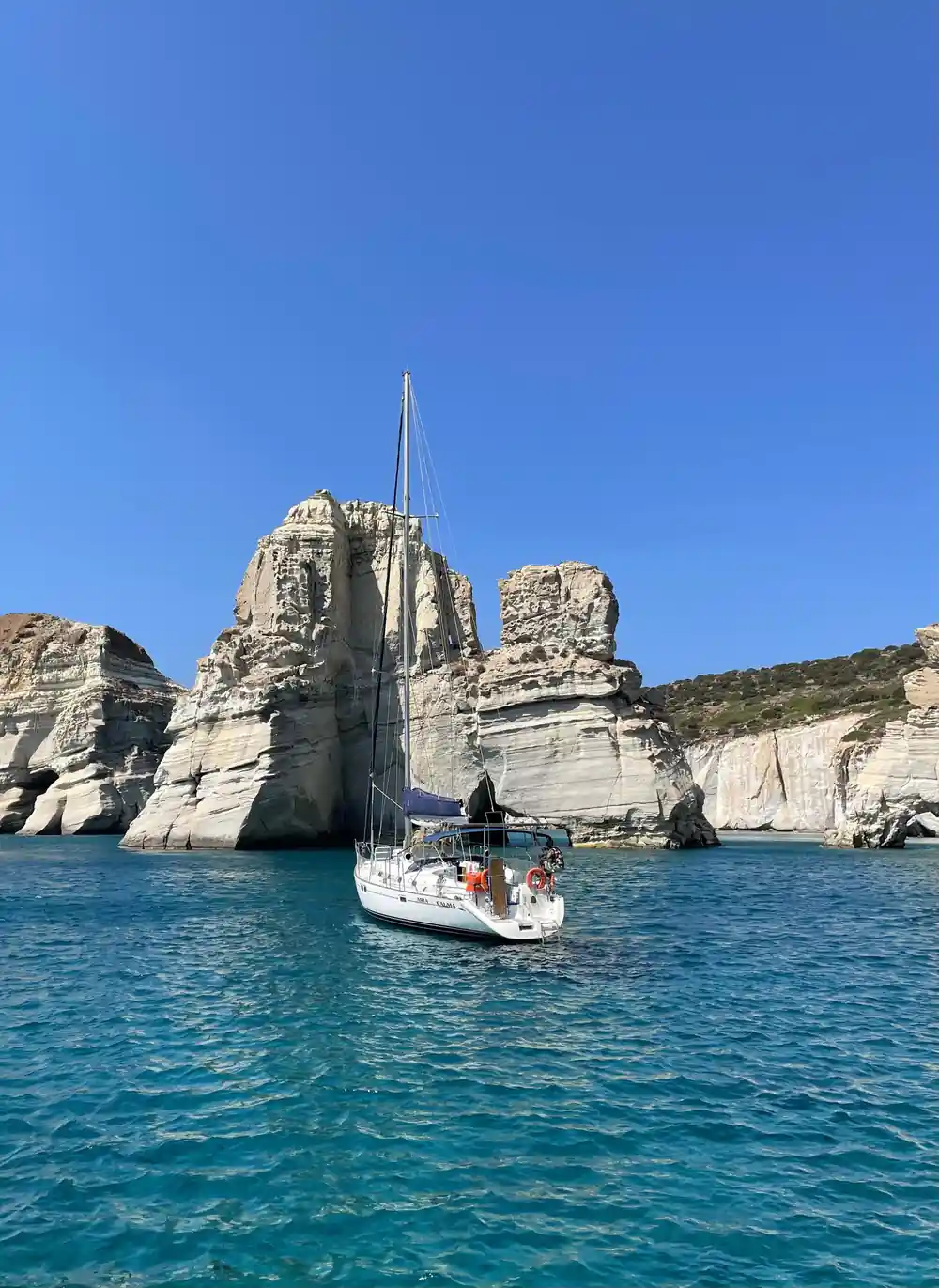
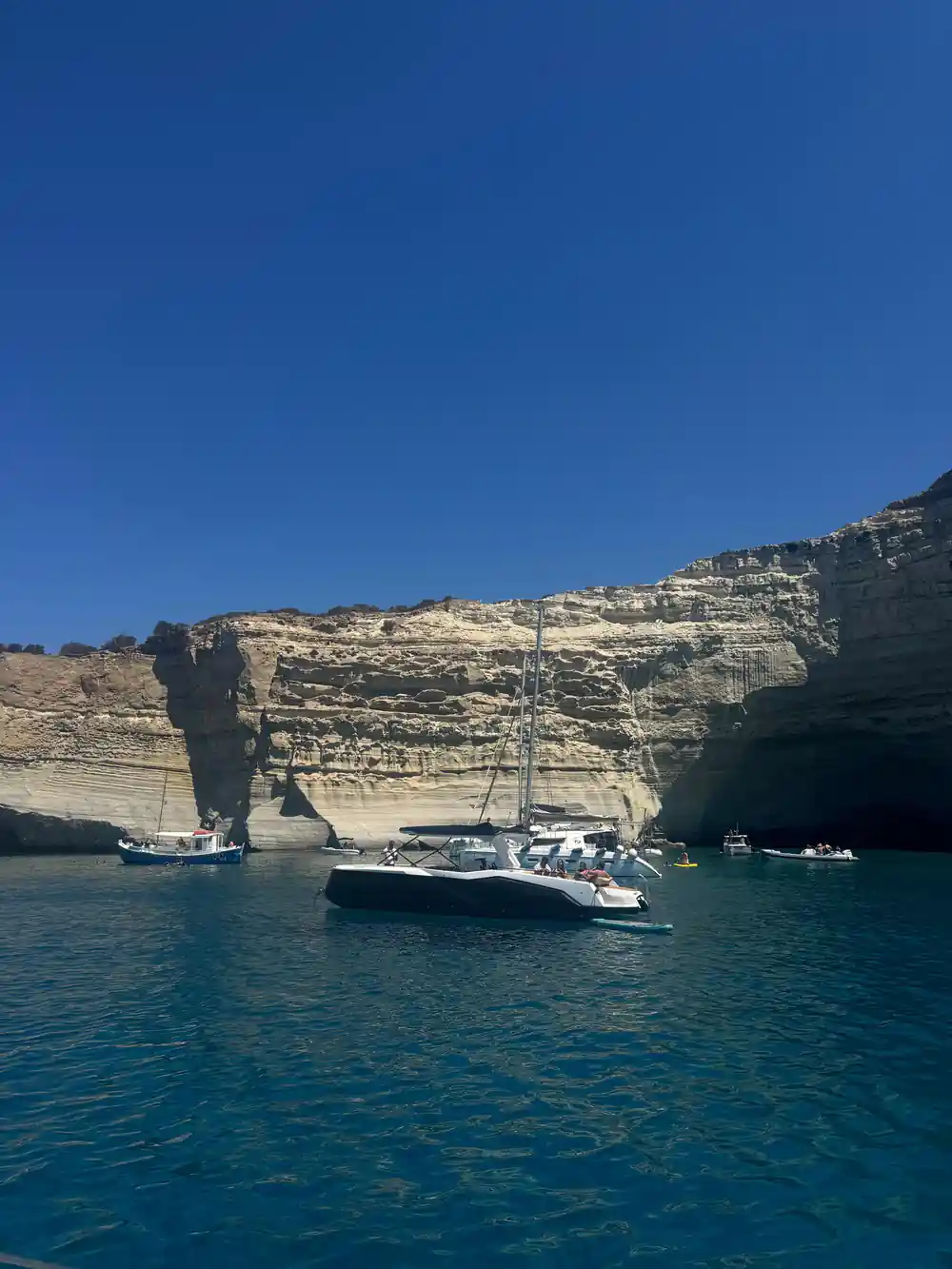
Kleftiko has a different character again. Its name means stolen in Greek, and it served as a pirate hideout, with supplies taken from passing ships and hidden in its caves and coves.[13] The full-day trips that include Glaronisia also list Sykia and Kleftiko among their stops, so one day can take in all three.[6]
Scale, and why photographs mislead
Photographs flatten Glaronisia. A wide shot turns the group into a single wall, a close shot makes one column look like a tabletop, and neither tells you how small the group really is. Three small islets is the whole of it, not a stretch of coastline.[1]
Scale lands when the boat idles beside the rock and a column you recognise from pictures turns out to be taller than the people on the foredeck. Give the day room to breathe. Full-day boat trips on Milos range from 6-8 hours and can even go up to 12 depending on sea conditions.[14] The distances between Sarakiniko, Polyaigos, Glaronisia and Kleftiko add up faster than you expect, and a long day feels short when you are in the middle of it.
Where it sits in the day, and how to reach it
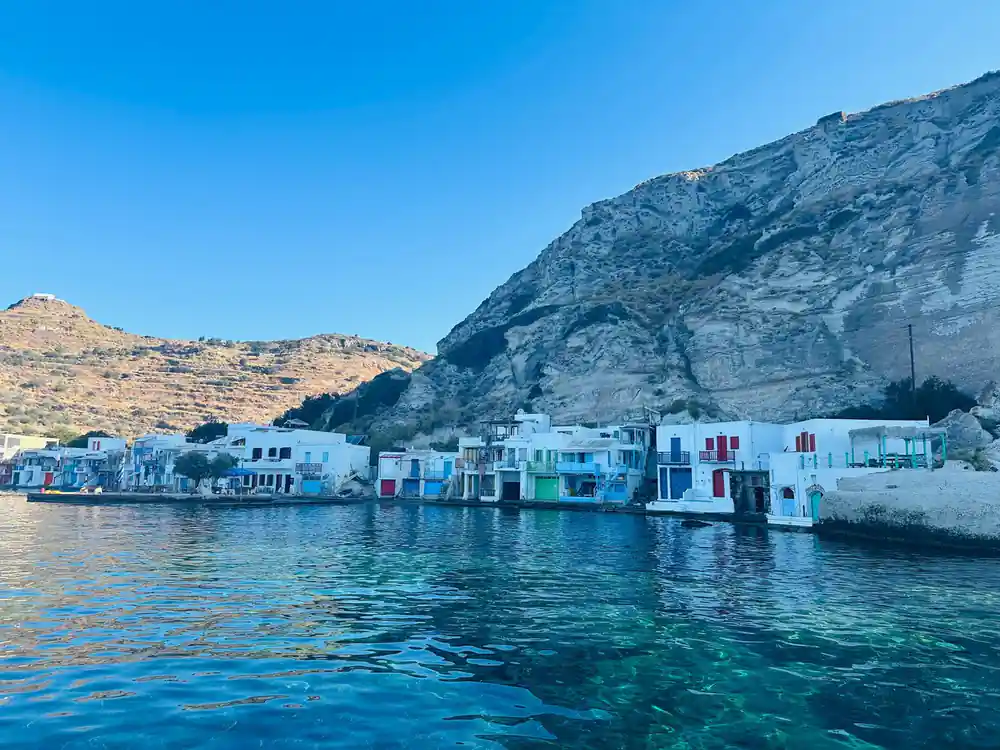
Boat tours around Milos start from Adamantas, which sits in the centre of the island.[2] That is where you walk the port and compare what is leaving that morning. The road north from Adamantas to Pollonia is the easy part of the journey, and Pollonia puts you closest to the northern islets, with cruises from there heading to Polyaigos, from US$115.[3]
The season runs from late spring through early autumn, May through October.[4] From July to September the Aegean around Milos sits at 23-26°C (73-79°F), which is ideal for long swims and snorkelling.[5] The Meltemi, the strong seasonal northerly wind, blows from late spring to early autumn and often peaks in July and August; in the right conditions it gives experienced crews an ideal sailing breeze.[15]
Glaronisia is normally seen from the deck as part of a longer route, and the trip that reaches it is best booked as a full day. Kleftiko, on the other hand, can also be reached on foot if you are fit and well prepared.[16] The northern islets sit offshore, so a boat is what makes the day work. Book the tour you want, check the meeting point the night before, and keep the morning free.
How long the Milos boat trips last
What the boat trips cost
From-prices from GetYourGuide listings[3][6][7][8]. No separate child rates published.
When to sail for Glaronisia
How to plan the day
Choose your boat
Full-day routes from Adamantas cover the north and the west in one loop, while half-day speedboat trips focus on Kleftiko and Sykia.
Book before you fly
The good boats fill up in high season. Free cancellation up to 24 hours in advance is standard on the main listings.[6]
Get to the port early
Boats leave from Adamantas in the centre of the island, so give yourself time to find the berth and pick up water.[2]
Watch for the columns
Glaronisia shows up as a low grey group of islets. Ask the crew which side to stand on, then put the phone down and simply look.
Keep the evening light
A long day on the water is tiring in the best way. Plan a slow dinner near the port rather than a long drive afterwards.
Glaronisia is one of the stops on the Kleftiko and Polyaigos day tour
from US$185Reserve now & pay later