The main points
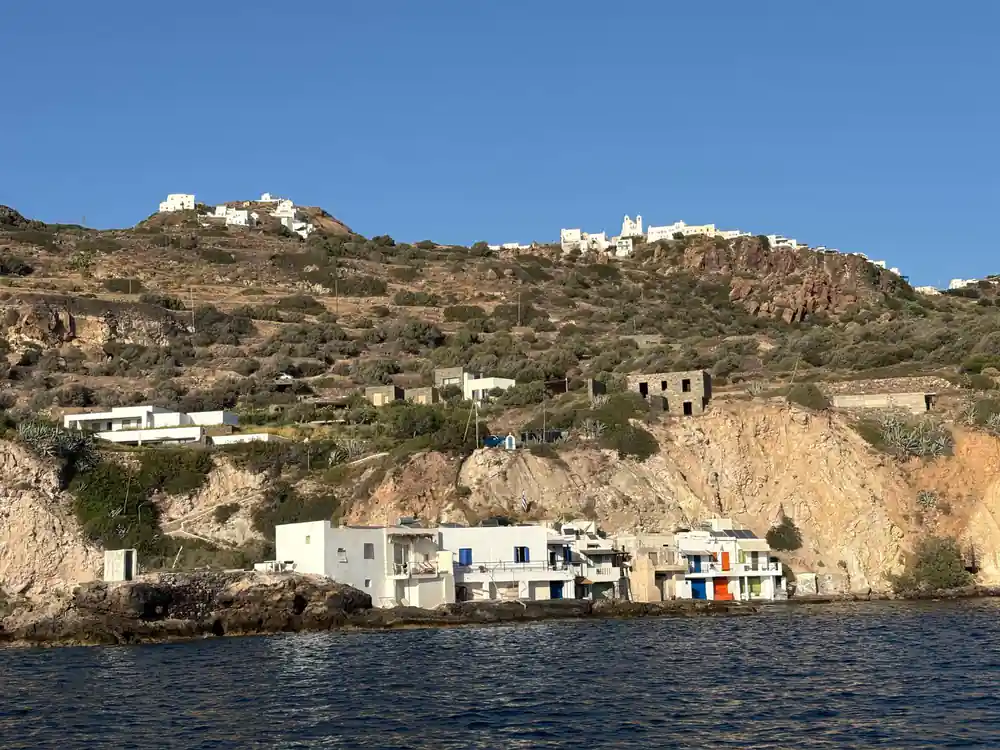
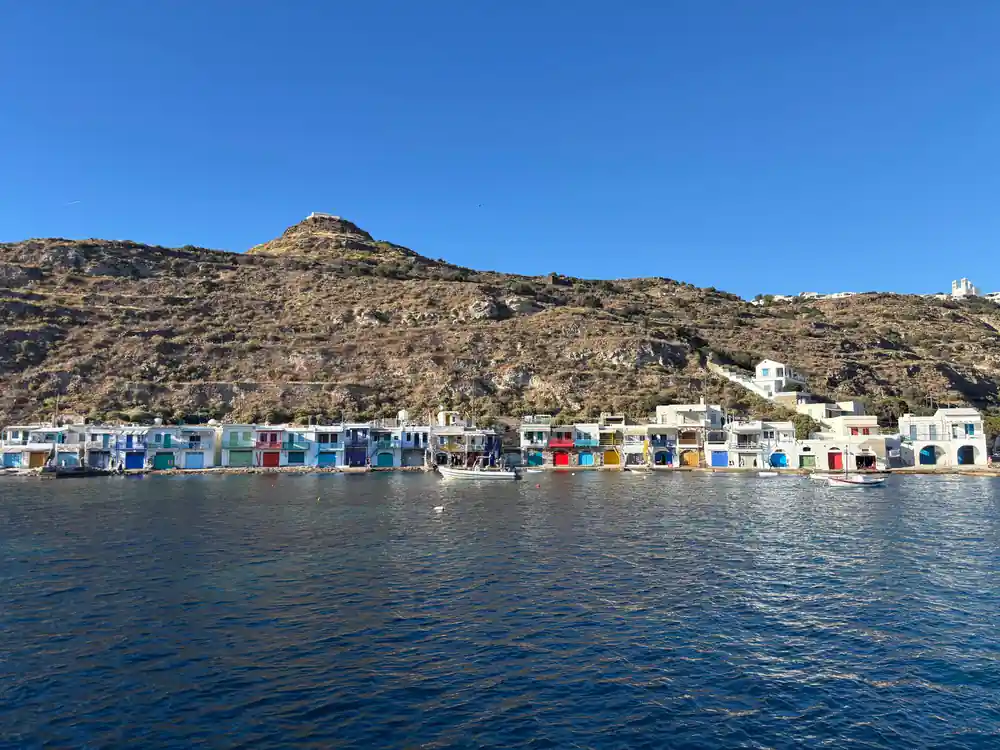
- Stone boathouses at the waterline, with a boat-sized arched door below and a small room above, built to keep a caique out of the weather.
- Klima village sits approximately 5 kilometres from the port of Adamas and is known for its multi-coloured fishing houses.[1]
- Boat tours around Milos start from Adamantas, located in the centre of the island, and the village is a short drive from the port.[1][2]
- From the water the whole row of painted doors and the hillside above line up in one view, which the beach alone cannot give you.
- Klima is the first stop on the listed route of the full-day tour booked from this site, which continues to Kleftiko and Polyaigos.[3]
- Top choice Kleftiko & Polyaigos Tour from US$185 Duration10 hours[3]Rating4.82 from 282 reviews[3]GuideEnglish[3]CancellationFree, up to 24 hours ahead[3] Check availability
- Guided Cruise to Kleftiko from US$152 Duration9.5 hours[4]Rating4.96 from 781 reviews[4]GuideEnglish, French, Greek[4]CancellationFree, up to 24 hours ahead[4] See this tour
- Milos & Polyaigos Sailboat from US$144 Duration10 hours[5]Rating4.92 from 1,913 reviews[5]GuideGreek, English[5]CancellationFree, up to 24 hours ahead[5] See this tour
Klima boathouse turquoise is located in Klima village approximately 5 kilometres from the port of Adamas making it one of the most visitable and romantic destinations of Milos with its trademark the multi coloured fishing houses.
Should you see Klima from a boat?
Know before you leave
- Pick a date early in your stay so a windy day can be swapped
- Book the boat ahead in high season
- Sun cream, hat and a light layer for the wind on deck
- A dry bag for your phone and camera
At the village
- Local buses link the Adamantas to Plaka run, so ask for current times
- A little cash for drinks in the villages above
- The shore is shingle and rough rock, so water shoes help
- Keep voices low and stay off private steps and terraces
What you are looking at on the Klima shore
A syrmata is a boathouse built for one job: keeping a boat out of the weather. The lower level is a tall arched doorway at the water's edge, wide enough to pull a caique straight in off the sea. Above it sits a single room with a small window, reached by an outside stair or a wooden ladder. The walls are thick stone or whitewashed plaster, and the doors open almost straight onto the water, so you hear the sea first thing in the morning and last thing at night.
At Klima the boathouses sit in a long shallow curve below the road. The village is approximately 5 kilometres from the port of Adamas and is known for its multi-coloured fishing houses, described as one of the most visitable and romantic destinations on Milos.[1] Up close the paint is faded and repainted, the wood is salted grey, and no two doors are quite the same size, because each was built around a different boat.
Klima Milos: a waterline with a long memory
Milos has been a working island for a very long time. Mineral activity here began around 8000 BC with the mining and trading of obsidian, a hard black stone of volcanic origin that was used to make tools and weapons.[6] That trade moved across the same water the tour boats use now, which is worth remembering when the coast starts to look like a set of photographs: this was a harbour economy long before it was a holiday one.
The boats that carry visitors around Milos today start from Adamantas, which sits in the centre of the island.[2] From the quay the route works along the coast, and Klima is the sort of stop that catches people out, because it does not look like a resort at all. There are no sunbed rows and no beach bars, just a slipway, a handful of doors and the hillside climbing behind them.
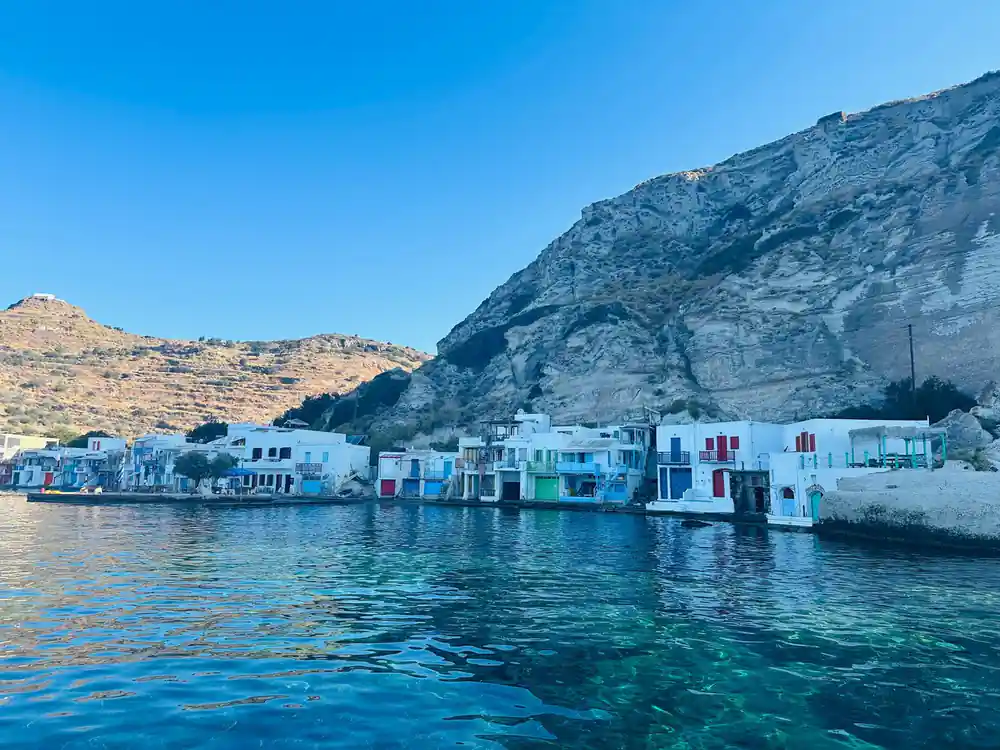
Painted doors open almost straight onto the water below the village.
The coloured doors and the village above
The doors are why people stop and stare. Each owner paints their own, so blues sit next to greens, deep reds next to whites, some with a slim outline around the arch and some with a name or a number over the lintel. The houses stand close together, so the row reads from the water as a bright patchwork against pale rock, and it changes with the light through the day.
Above the waterline the land climbs in dry stone terraces, low walls and caper bushes, with the road bending up towards the villages of the interior. Sarakiniko Beach, the most well-known shore on Milos, lies just five kilometres from Plaka.[7] The white rock and the syrmata belong to the same volcanic island, but they could not look less alike: one is smooth and bare, the other is a row of small painted rooms pressed against the sea.
Are the syrmata still used?
Many of them are. A working boathouse looks like a garage with a sea door: an outboard motor on a stand, coiled rope, nets, a bucket, a folding chair, a bottle of oil on a shelf. Others have been restored into small summer houses, with a kitchen tucked into the old boat space and a bed in the room above. Both versions are private, and both come alive in the warm months.
The village keeps a low, working rhythm. In the morning you might see someone hosing down a deck or mending a net; by the middle of the day the shore is quiet and hot. If you walk down, keep your voice down and stay off the terraces and steps, because these are homes and stores rather than exhibits. The easiest way to enjoy them from land is to sit at the far end of the beach with a drink and watch the water move.
from US$185
Full-day Milos boat tour with meals, rated 4.82 from 282 reviews, with free cancellation up to 24 hours in advance.[3]
Getting to Klima from Adamantas or Plaka
Klima is close to the port. It sits approximately 5 kilometres from Adamas, so the drive takes only a few minutes, and the last stretch drops steeply to the water with parking on the slope above the houses.[1] If you are choosing a base, Adamantas is the practical one for boat days, since the tours leave from there, in the centre of the island.[2] Plaka is the hill village, and the Adamantas to Plaka bus is the easy way to move between the two without a car; ask locally for the current times.
On foot, the road down to the shore is short but exposed, and there is little shade on the way. Water shoes are a good idea, because the beach in front of the syrmata is shingle and rough rock rather than sand, and the shallows are stony. Swimming here is lovely in calm weather; in a northerly blow the water gets choppy and the shore can feel raw, so judge it on the day.
Seeing Klima from the water
From the sea the village makes sense all at once. The syrmata line up in one row, every door faces the water, and the hill rises behind them with nothing in the way. On land you can stand in front of one or two houses and guess at the rest; from a boat the whole curve is laid out at once, slipways and shelters and all.
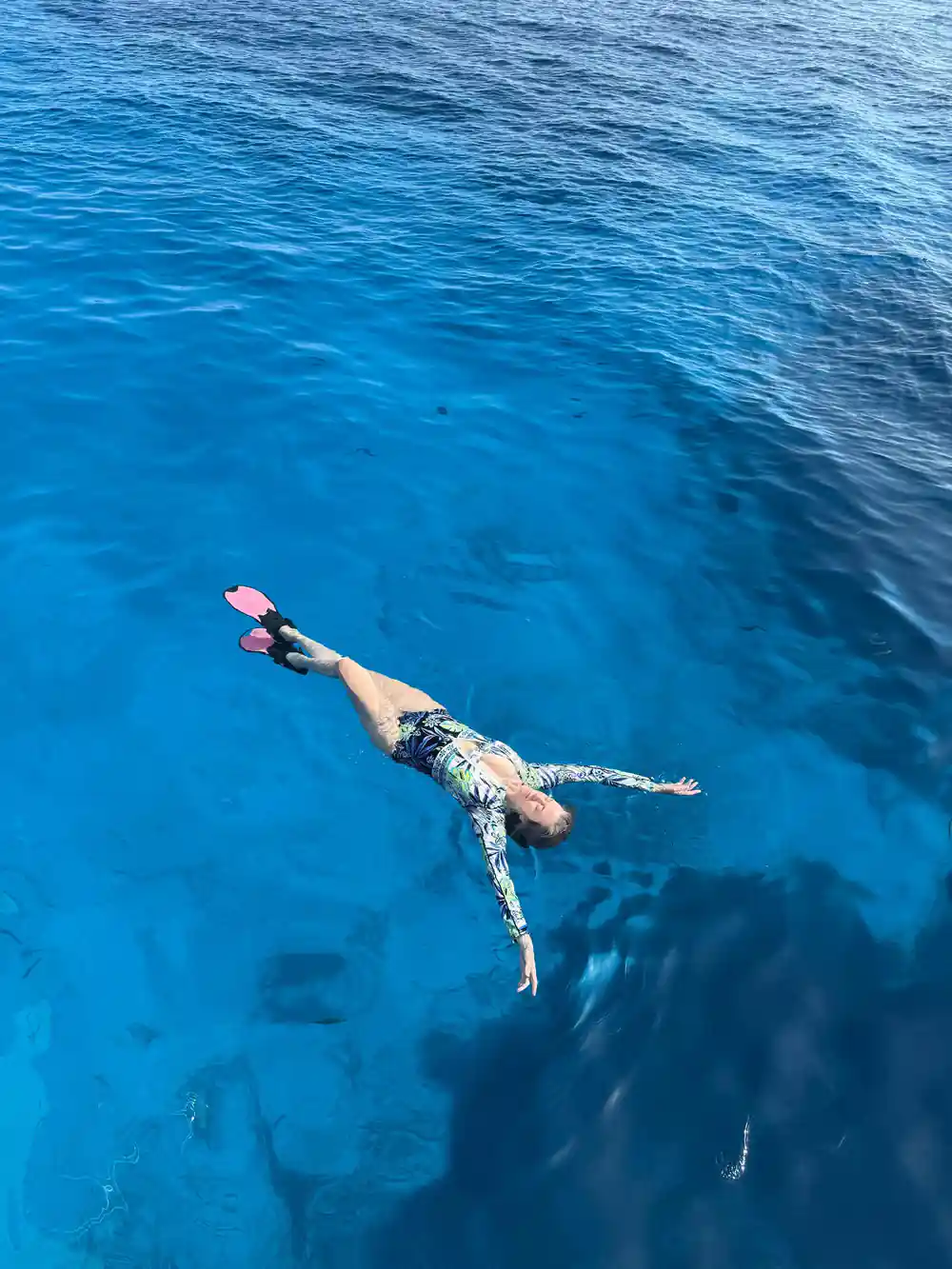
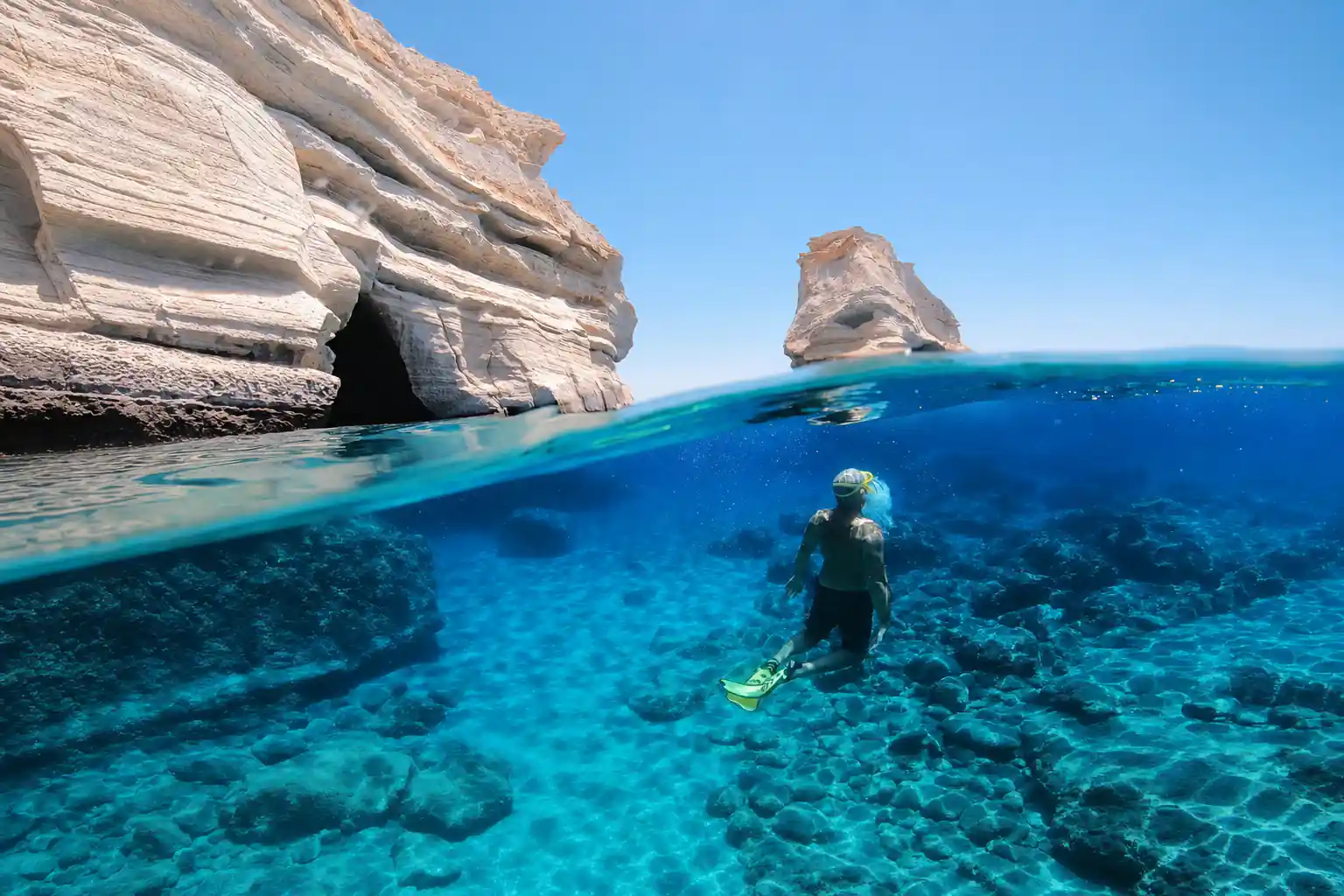
Swimming is a big part of these days. Around Milos, the Aegean in July to September is 23-26°C (73-79°F), described as ideal temperatures for long swims and snorkeling.[8] Bring a mask even if you only plan to float: the water is clear over pale rock, and the shallows show every stone. The full-day tour that this site books is listed as a Kleftiko and Polyaigos swimming trip with meals, and it runs for 10 hours.[3]
Boats are not the only way along this coast. A kayaking tour on Milos starts from a kiosk at Fyriplaka beach and paddles east to Tsigrado and Gerakas, following the volcanic coastline.[9] And if you want Kleftiko without a boat at all, you do not need a tour to reach it; most visitors arrive by sea, but it is also possible to hike there on your own.[10]
When Klima comes on the route
On the full-day tour booked from this site, Klima is the first stop on the listed route: Klima, Arkoudes, Sarakiniko Beach, Glaronisia, Pollonia, Poliegos, Thiorichia Beach, Gerakas Beach, the Kleftiko Caves, Sykia Cave and Vani Beach.[3] The boat is listed at 10 hours, with a live English guide, from US$185.[3]
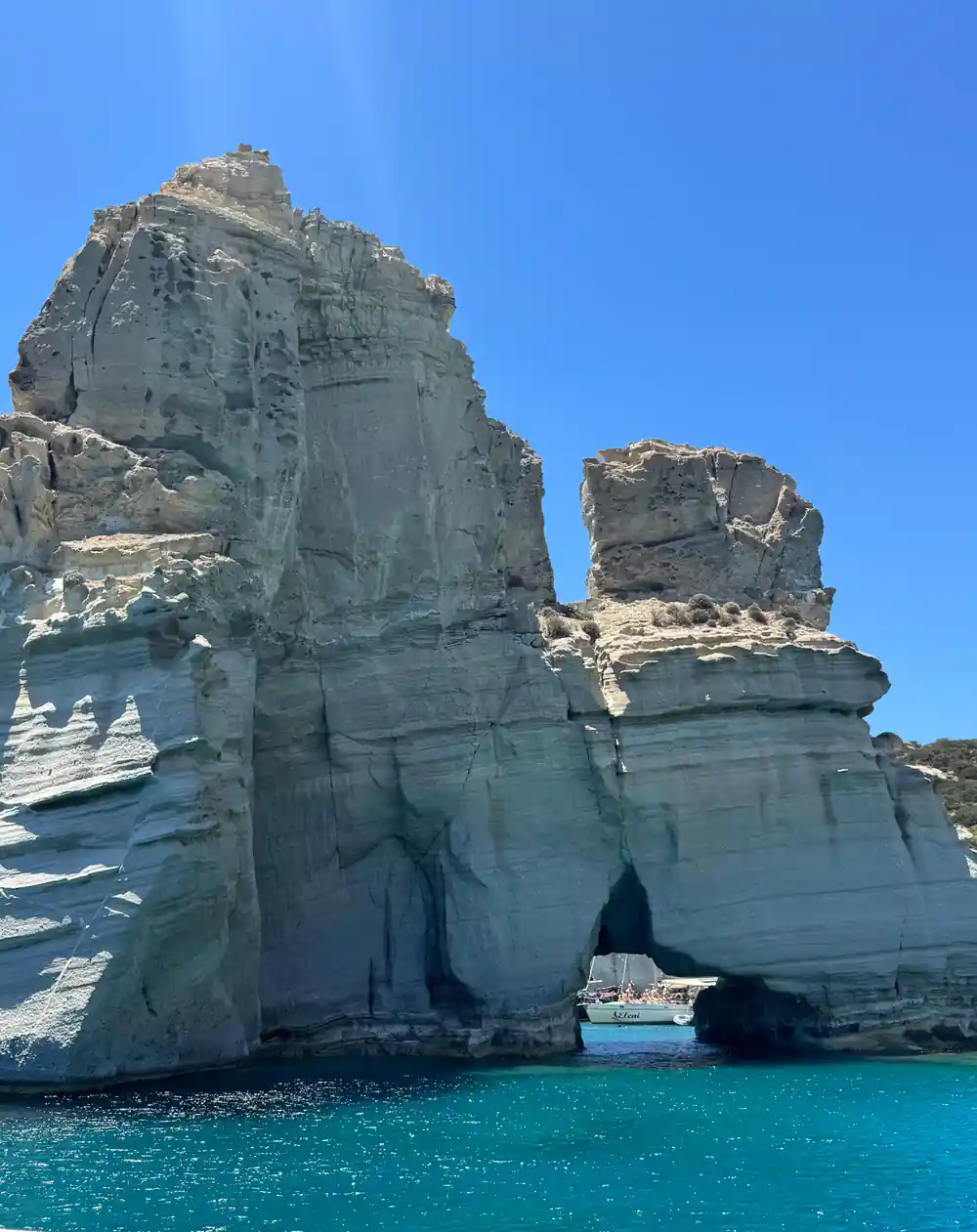
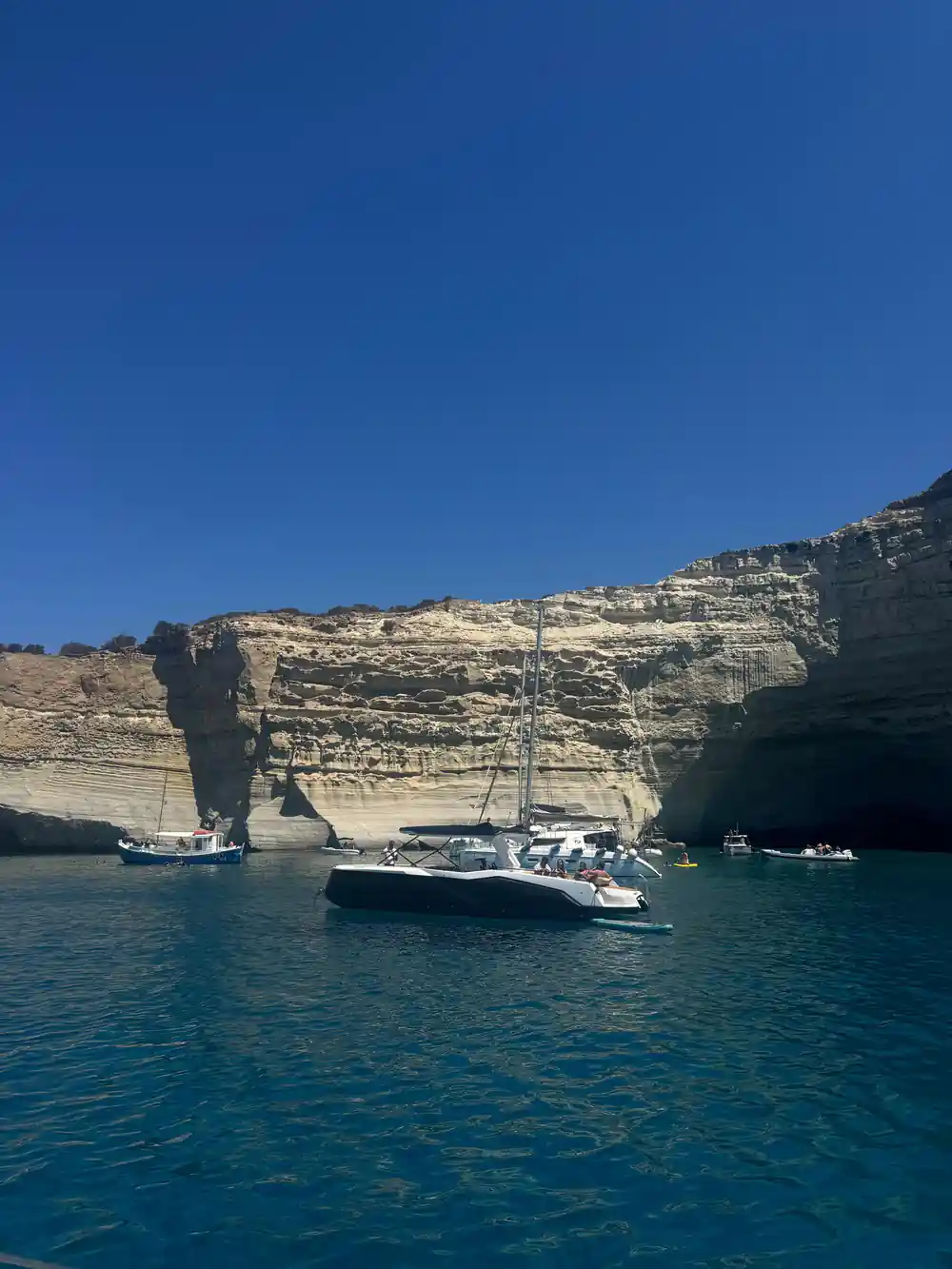
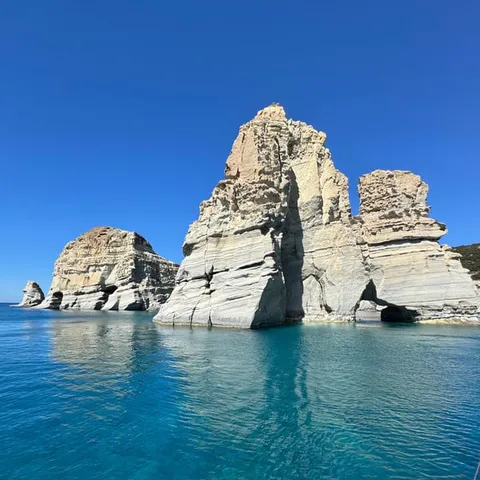
The rest of the day brings the famous set pieces. Glaronisia is a group of three small uninhabited volcanic islets off the north coast of Milos, famous for hexagonal basalt columns that rise straight out of the sea.[11] Polyaigos is the biggest uninhabited island in the Aegean.[12] Kleftiko has a history as a pirate hideout, and its name means stolen in Greek.[13] Sikia Cave was once completely covered, until its roof collapsed and left an open top showing the blue sky.[14]
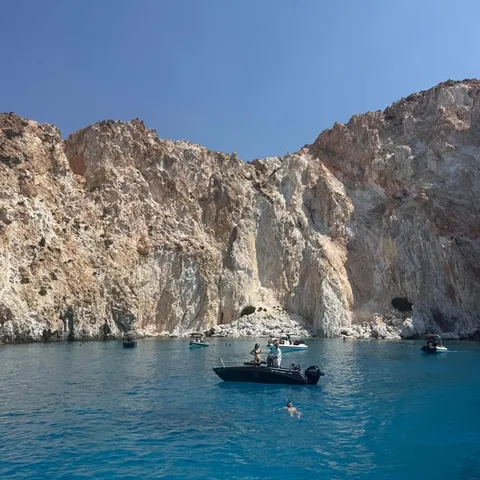
Timing matters more than any packing list. Full-day boat trips around Milos run 6-8 hours and can stretch up to 12 depending on sea conditions.[15] The season runs from late spring through early autumn, specifically May through October, and the Meltemi, a strong seasonal northerly wind, often peaks in July and August.[16][17] Build a spare day into your plans so one windy morning does not cost you the whole outing.
How long these Milos boat tours last
Durations as listed on these GetYourGuide tours: 5 hours[18], 8 hours[19], 9.5 hours[4] and 10 hours[3].
From-prices per person on these Milos boat tours
US dollar from-prices from these tour listings: from US$185[3], from US$152[4], from US$144[5] and from US$155[18].
When to book and when to go
Planning the boat day
Book the full-day tour
Reserve ahead in high season and keep your first days free, so you have room to move the trip if the wind picks up.
Start from Adamantas
Boats leave from Adamantas in the centre of the island. Arrive with time to find the right quay and a parking spot.
Watch for Klima early
Look for the row of painted doors as the boat works along the coast, when the light is soft on the hillside behind them.
Swim when the boat stops
Bring a mask. The clearest water is off the rocky stops, and the crew will show you where it is safe to get in.
Keep energy for Kleftiko
The white cliffs and sea caves come later in the day, so eat lunch and keep something in reserve for a second swim.
See Klima from the water on the Kleftiko and Polyaigos boat tour
from US$185Reserve now & pay later